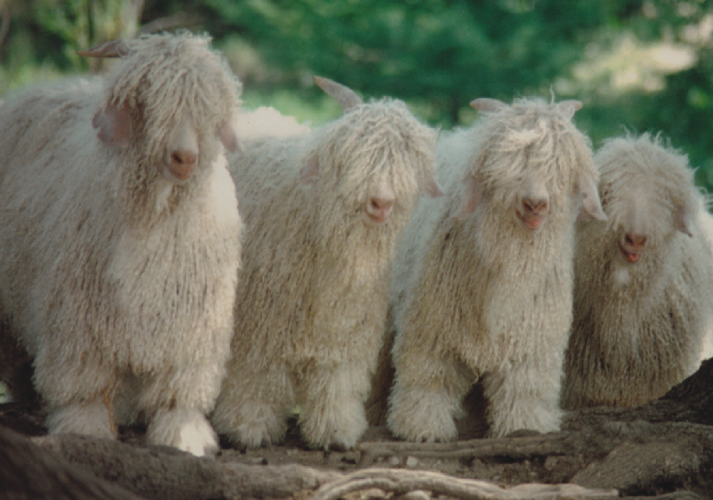
Alpaca
There are two different breeds of Alpacas, Huacaya and Suri, producing 22 different color options. Most Alpacas are Huacaya, about 82%, and these animals produce hair that has a crinkle. Suri Alpacas produce penciled hair and their hair hangs down like “dreadlocks.” Alpaca fleece is soft, lightweight, and strong. Did you know that Alpaca hair is nonflammable and it has hypoallergenic properties? For people who find themselves allergic to wool, alpaca may be an option. Alpaca hair does not have a problem with storing odors like some other natural wools do.
Mohair
Angora Goats produce long hair known as mohair. The fiber is known for its shiny luster, durability, and “curls.” Mohair has some lanolin, a natural way substance that aids in the sheen of the hair and is mainly removed during processing. Mohair is nonflammable and durable. When you blend Mohair with other fibers it will add sheen. Mohair can be easily dyed. It is considered a luxury fiber. There a variety of stable lengths available and most Mohair averages 5-6 inches. Mohair is soft and “airy” and is available in whites, browns, blacks, grays, fawn, and various other colors. Angora Goats produce more fleece than Cashmere Goats but the fleece is not as soft as cashmere.
Cashmere
Cashmere comes from cashmere goats and it is the undercoat of the neck region of the animal. The fiber from the animal needs to be processed so the fine undercoat is separated from the longer, coarser “guard hair” or outer layer. The fiber is known for its heat insulating qualities. The fleece is can be dyed or it comes in a variety of natural colors.
Wool
Wool comes from sheep. It is estimated there are over 1000 different distinct sheep breeds. Wool has hair consists of pointed scales which is why it feels prickly to some people with sensitive skin. Wool like Mohair has lanolin, a natural waxy substance that is removed when processed. Wool is moisture absorbing and is not as warm as Alpaca. Sheep’s wool is flammable and is not hypoallergenic.
Camel Hair
Camels have two layers of hair. The outer layer has “guard hair” and is course with the undercoat of a camel producing extremely soft and fine fiber. Of all the wools, camel hair has the best insulation qualities. The hair is not a strong hair and its durability is weaker when compared to wool.
Angora Wool
Angora Rabbits produce Angora Wool. The fibers from the Angora Rabbit are hollow and feather light, making the fiber fragile. The fiber is good for retaining heat and it is moisture wicking. Often Angora Wool is blended with other fiber and wools to “fluff” them up, adding softness and volume.
Angora Goats originated in Ankara, Turkey and arrived in the United States in 1849. Angora Goats are docile animals with flopping ears and horns. Initially bred to be white, Angora Goats now produce a variety of fleece colors including black, brown, fawn, red, and cream. Mature Angora does weight about 75 pounds and bucks weigh on average about 150 pounds. Angora Goats are typically sheared twice each year producing between and 10 and 16 pounds of mohair per year. Most animals have long primary hairs and shorter curly secondary hairs which grow together. Longer primary hairs called kemp are not desired. Mohair grows about 1 inch a month. One ounce of Mohair produces about 1 ounce of yarn.
Mohair Terms
Fleece – all the hair from one goat after shearing
Skirting – removal of leg, underbelly, face, and soiled hair
Clip – all the hair from one goat for the entire year (goats are sheared twice) or all the hair from the entire herd of goats for one shearing
First Clip – the hair from the first shearing of an animal, the best for baby clothing and baby blankets
Staple – individual hairs in a fleece, longer than 4 inches, is best for spinning
Micron – (micrometer) is the measurement used to express the diameter of wool fiber. The lower the value the finer the wool. Some animals may be adults and still produce “kid” or fine micron count fiber
Kid Fiber – First clip of the yearling Angora Goat and has a natural curl at the end. Some adults may have fine “kid” fiber which refers to the micron or measurement of the fiber
Yearling Fiber – Second clip of the Angora Goat and does not have the natural curl at the end due to being sheared once already. Still may be very low micron count and fine
Adult Fiber – Clippings from the adult Angora Goat and can range from “kid” fine to course in micron measurement
Lock – fibers that cling together and hang off the animal
Carding – a process that lays the fibers in the same direction in preparation for spinning
Spinning – turning mohair into yard, it must be washed and carded first
Character – the crimp of the hair
Style – refers to the twist